
Sailing Kos & the Dodecanese
Colourful Harbours, Eastern Aegean Shores and Island-Hopping Ease
The Dodecanese feels different from other Greek island groups. Set close to the Turkish coast, these islands sit at a historic meeting point between Greece, the eastern Mediterranean and Asia Minor. The result is a sailing region rich in colour, culture and contrast — where medieval towns, neoclassical harbours, volcanic landscapes and quiet island villages can all form part of the same journey.
For those looking beyond the better-known Cyclades or the gentle Ionian, sailing Kos and the Dodecanese offers something more expansive. Distances can feel a little more adventurous, the atmosphere more layered, and the sense of place more varied. This is Greece with an eastern Aegean accent: elegant, sunlit and full of history.
Why Sail Kos & the Dodecanese?
Kos and the Dodecanese reward travellers who enjoy culture as much as coastline. These are not islands defined only by beaches and anchorages, although there are plenty of both. They are places shaped by ancient healing sanctuaries, medieval knights, volcanic geology, sponge-diving traditions and centuries of maritime exchange.
Rhodes brings scale, history and grandeur. Symi offers one of the most beautiful harbours in Greece, with pastel neoclassical houses rising steeply from the waterfront. Nisiros adds drama, with its volcanic caldera and quiet whitewashed villages. Kos combines beaches, café life and ancient heritage, while Tilos and Halki bring the slower rhythm of smaller island Greece.
Together, they create a sailing journey that feels varied without losing coherence — historic, colourful and quietly sophisticated.
A More Expansive Greek Islands Journey
Compared with some Greek island sailing areas, Kos and the Dodecanese can involve longer passages and a greater sense of movement. That is part of the appeal. Rather than a short-hop itinerary focused only on neighbouring bays, this route can feel like a proper Aegean voyage.
This makes it especially well suited to guests who enjoy the journey as much as the destination. Days at sea are balanced by memorable arrivals: the amphitheatre harbour of Symi, the volcanic presence of Nisiros, the medieval walls of Rhodes, or the gentle waterfront of Halki.
The sailing has a sense of progression. Each island feels distinct, yet the region holds together through its shared eastern Aegean character — warm stone, clear water, harbour tavernas, historic layers and light-filled horizons.
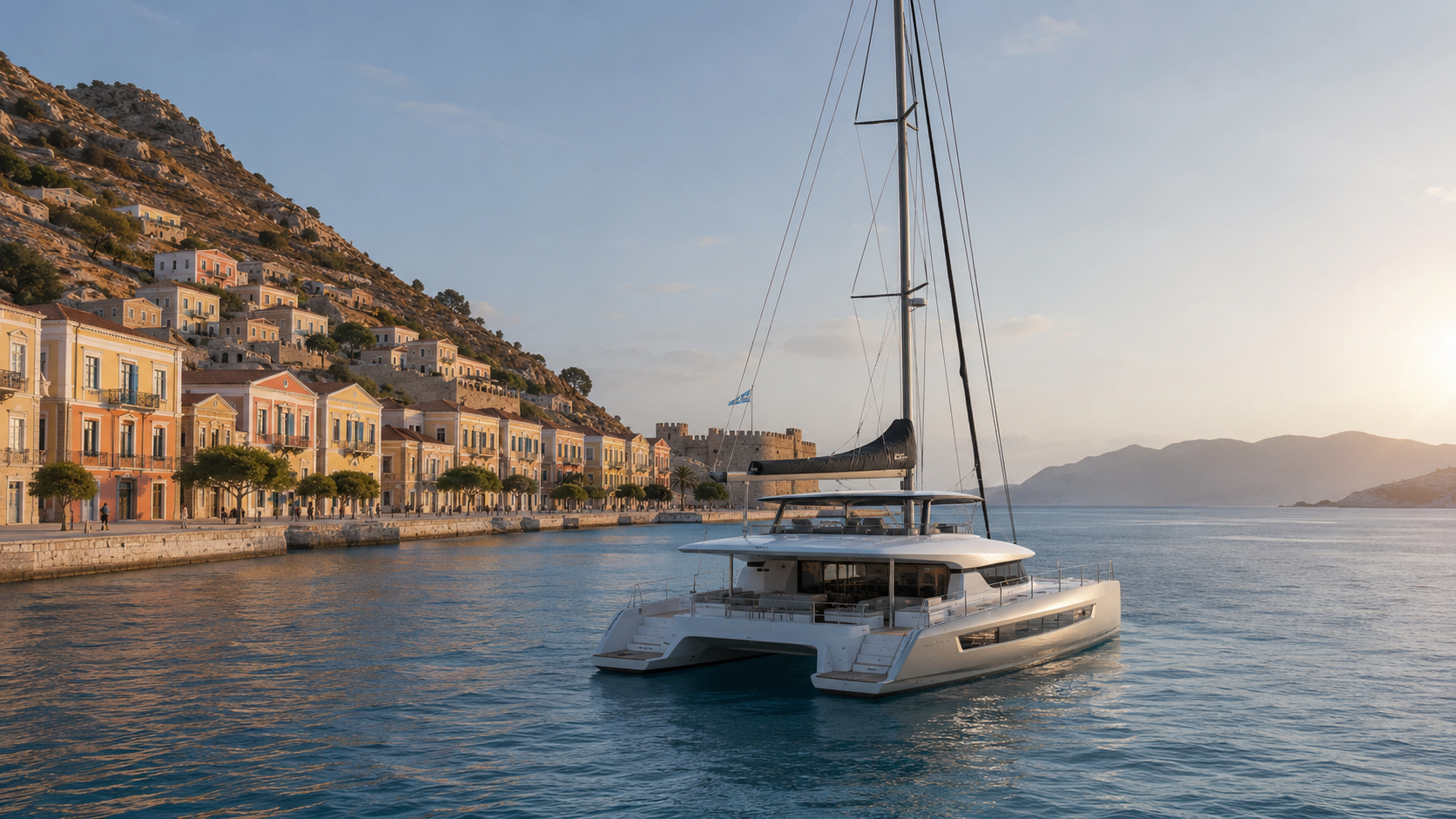
Colourful harbours and historic arrivals define sailing in the Dodecanese.
Rhodes: A Grand Historic Beginning
Rhodes gives this Dodecanese journey a powerful opening note. Its medieval Old Town is one of the most atmospheric in Europe, with stone walls, cobbled streets, knights’ palaces and shaded squares creating a strong sense of arrival. It is a place where history is not hidden away, but woven into the everyday life of the town.
For a sailing itinerary, Rhodes works beautifully as both a beginning and an ending. Guests can explore its historic centre, enjoy waterfront dining, or simply absorb the scale of one of the great island capitals of the Aegean before setting out across the water.
The contrast between the grandeur of Rhodes and the smaller islands that follow gives the route much of its rhythm.
Symi: Colour, Elegance and Harbour Life
Symi is often one of the emotional highlights of sailing Kos and the Dodecanese. Its harbour is instantly memorable: pastel mansions, steep hillsides, calm water and a sense of theatrical beauty that feels almost painted into the landscape.
Yet Symi is not only beautiful. It has a distinct island identity, shaped by sponge diving, maritime trade and neoclassical architecture. Today, it offers boutique shops, harbourfront cafés, elegant tavernas and quiet lanes that invite slow exploration.
Arriving by sea gives Symi its full effect. The harbour unfolds gradually, becoming more vivid as the yacht draws closer — a perfect example of why sailing can reveal a destination differently from travelling by land.
Nisiros: Volcanic Drama and Quiet Villages
Nisiros brings a completely different mood. Smaller, quieter and more dramatic, it is best known for its volcanic landscape. The island’s caldera gives the journey a striking geological dimension, with steaming vents and pale, lunar textures contrasting sharply with the blue of the surrounding Aegean.
Away from the caldera, Nisiros remains deeply traditional. Mandraki and the island’s villages offer whitewashed streets, simple tavernas, monasteries and a gentler pace of life. It is an island that feels less polished than Symi and less grand than Rhodes, but that difference is precisely its charm.
For guests who enjoy variety, Nisiros adds depth and surprise to the itinerary.
Kos, Tilos and Halki: Softer Island Rhythms
Kos introduces a livelier note, combining beaches, café culture, palm-lined streets and ancient heritage. Its Asklepion, associated with healing and Hippocratic tradition, adds a classical dimension to the island’s appeal. Kos Town itself brings energy, restaurants, waterfront life and easy access to the broader Dodecanese.
Tilos and Halki then soften the pace again. Tilos is peaceful and nature-rich, with quiet villages and secluded coves. Halki is smaller still, known for its pastel harbour, calm waterfront and unhurried atmosphere.
Together, these islands create balance. After the grandeur of Rhodes, the elegance of Symi, the drama of Nisiros and the energy of Kos, Tilos and Halki bring the voyage back to stillness.
Culture and Cuisine in the Dodecanese
The Dodecanese is particularly rewarding for guests who enjoy combining sailing with cultural and dining experiences ashore. Rhodes offers medieval streets, historic architecture and atmospheric evening dining. Symi is ideal for seafood by the harbour, particularly simple dishes served against a backdrop of colourful houses and still water.
Kos brings local wines, ancient sites and lively tavernas, while smaller islands such as Tilos and Halki offer a more intimate version of Greek island hospitality: meze, fresh fish, quiet waterfront tables and warm, unpretentious service.
This is not a region where culture and cuisine need to be added artificially to the sailing experience. They are already part of the journey.
Who Is Kos & the Dodecanese Best For?
Kos and the Dodecanese are ideal for travellers who want a Greek Islands sailing holiday with a stronger sense of history, movement and contrast. The region may particularly appeal to guests who have already experienced the Ionian or Cyclades and are looking for a different expression of Greece.
It suits those who enjoy ancient and medieval history, colourful harbour towns, a slightly more expansive sailing rhythm, distinctive island stops and a blend of culture, cuisine and quiet anchorages.
It is perhaps less about pure simplicity and more about richness. The Dodecanese does not feel like a single-note destination. It feels like a journey through connected but highly individual islands.
Sailing Kos & the Dodecanese with Elysian
An Elysian Kos and Dodecanese itinerary is designed to bring this variety together in a calm, curated way. Rather than trying to see too much, the route balances historic centres, elegant harbours, volcanic landscapes and quieter islands into a journey that feels full but not rushed.
Guests can enjoy the comfort of a modern crewed yacht, the ease of travelling by sea, and the pleasure of arriving each day somewhere with its own atmosphere and story. The result is a Greek Islands sailing experience that feels cultured, colourful and quietly memorable.
For those drawn to Greece but looking for something beyond the familiar, Kos and the Dodecanese offer one of the most rewarding journeys in the eastern Aegean.
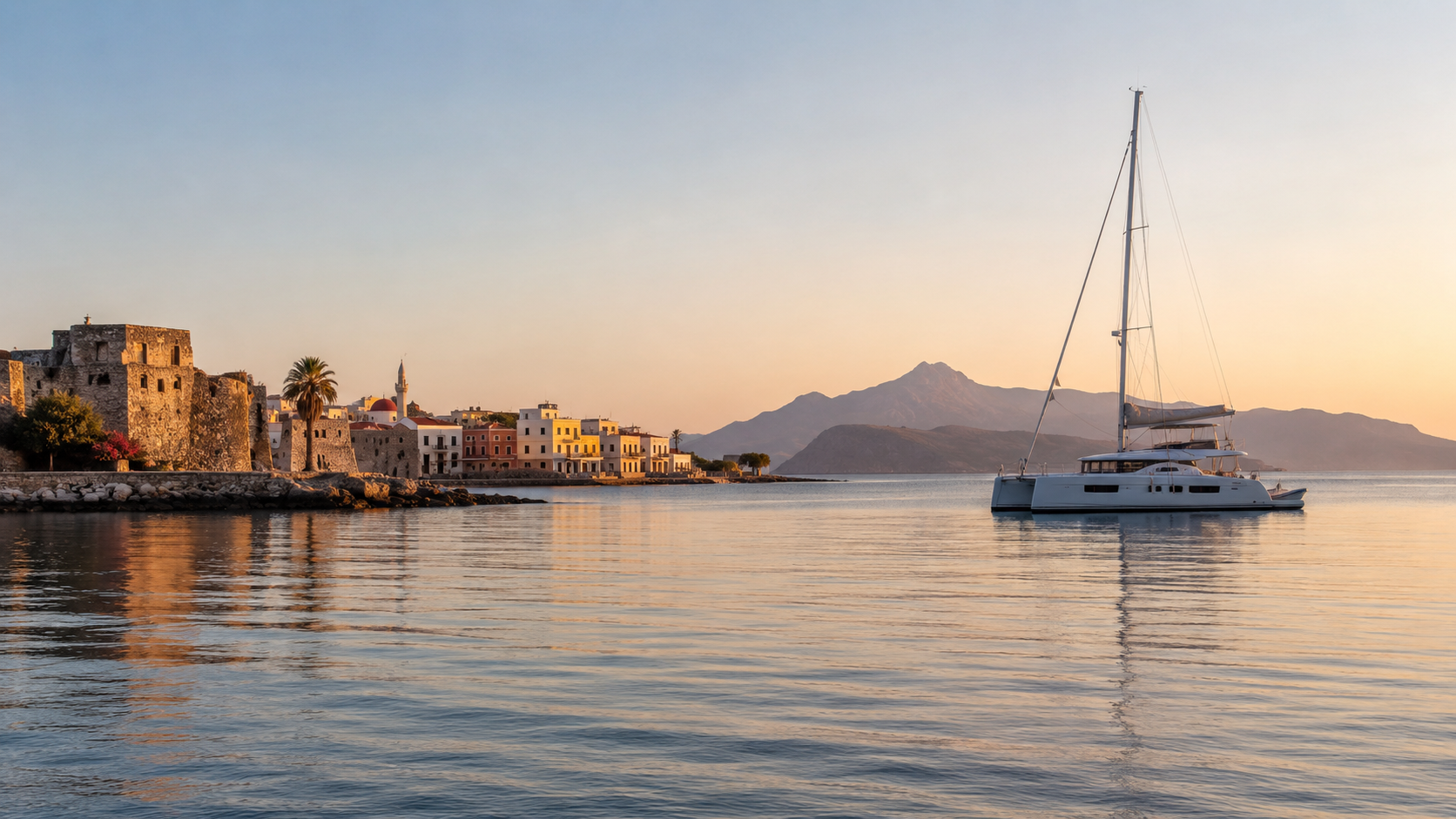
A quiet close to a Dodecanese journey shaped by history, colour and island life.
Continue Exploring the Greek Islands
Discover more Elysian Insights on sailing the Greek Islands, culture and cuisine.